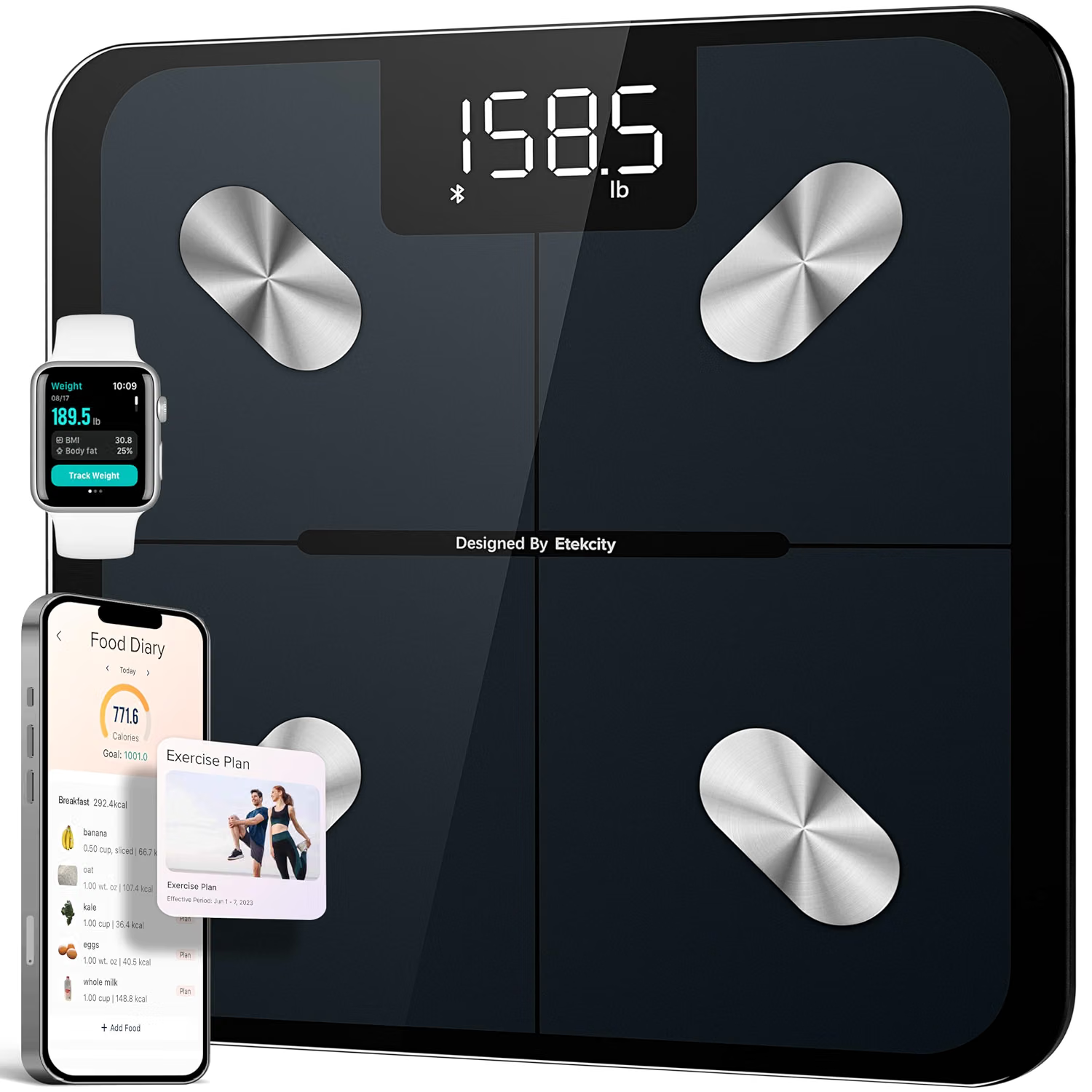
A bathroom scale has traditionally had one simple job: display a person’s body weight. Digital technology has expanded that role considerably. Modern smart scales can connect to smartphones, record measurements over time, and provide additional body-composition estimates alongside a conventional weight reading.
The Etekcity Smart Scale for Body Weight, Body Fat and BMI is designed around this connected approach to personal measurement. Rather than relying solely on the number displayed on the scale, users can use compatible digital features to organize measurements and observe changes over time. The product listing also identifies the scale as FSA eligible, although eligibility and reimbursement depend on the applicable FSA plan and current rules.
For anyone considering a smart scale, understanding what these measurements actually mean is more important than simply seeing a long list of numbers. Body weight is relatively straightforward, but measurements such as body fat percentage and BMI have limitations and should be interpreted within their proper context.
A smart scale can therefore be useful as a tracking tool, but it should not be treated as a medical diagnostic device unless the manufacturer specifically states otherwise and the relevant measurement has appropriate regulatory authorization.
This guide explains how a connected body-weight scale works, what its different measurements can represent, how Bluetooth-based tracking can fit into a personal routine, and what users should consider when interpreting body-composition information.
Understanding the Etekcity Smart Scale
The Etekcity Smart Scale is a digital bathroom scale designed to measure body weight while providing additional body-composition information through its connected features.
Its basic function is familiar. A person steps onto the scale, and the device measures body weight.
The smart aspect comes from the additional digital functionality. Depending on the supported application and configuration, measurements can be transferred to a smartphone through Bluetooth, allowing users to maintain a history instead of relying on memory or manually recording every measurement.
This can change the purpose of a scale.
Instead of asking only, “What do I weigh today?” users can look at a series of measurements and ask, “How has this number changed over several weeks?”
That longer-term perspective can be more informative than a single measurement because body weight naturally fluctuates from day to day.
Factors such as hydration, food intake, exercise, sodium consumption, clothing, and the time of day can influence the number displayed.
The same principle applies to body-composition estimates. A single reading should not automatically be interpreted as a definitive description of a person’s physical condition.
Key Features
Body Weight Measurement
Body weight is the most familiar measurement provided by a bathroom scale.
Tracking weight can be useful for people who want a simple record of changes over time. It can also be one component of a broader fitness or wellness routine.
However, daily weight fluctuations are normal.
For example, a person can see a different reading from one morning to another without experiencing a corresponding change in body tissue. Water balance alone can cause noticeable short-term changes.
For this reason, comparing measurements under reasonably consistent conditions can make trends easier to understand.
Some people choose to weigh themselves at approximately the same time of day, under similar circumstances, rather than comparing completely different situations.
Body Fat Percentage Estimates
One of the features that distinguishes a smart body-composition scale from a conventional bathroom scale is its ability to provide an estimated body-fat percentage.
Smart scales commonly use bioelectrical impedance analysis, or BIA, to estimate body composition.
BIA works by passing a very small electrical current through the body and measuring electrical impedance. The resulting data can then be combined with information such as body weight and user characteristics to generate an estimate.
The word “estimate” is important.
A home smart scale does not directly observe every gram of body fat. Its body-composition result is generated through an algorithm and can be influenced by factors such as hydration and measurement conditions.
Consequently, body-fat readings are generally more useful for observing changes under consistent conditions than for treating a single number as an exact measurement.
BMI Information
BMI, or Body Mass Index, is another commonly provided measurement.
It is calculated from weight relative to height and is often used as a population-level screening measure.
BMI can be useful as a simple reference point, but it does not directly measure body fat.
For example, people with significant amounts of muscle can have a relatively high BMI without having a high body-fat percentage.
Likewise, BMI does not fully account for differences in body composition, age, sex, or individual health circumstances.
A smart scale can therefore make BMI convenient to track, but users should interpret it within its limitations.
Bluetooth Connectivity
Bluetooth connectivity allows compatible measurements to be transferred to a smartphone.
This can reduce the need to manually write down every measurement.
Instead, users can use the supported application to organize their information and view previous readings.
The benefit of digital tracking becomes more apparent over time. A record containing several weeks or months of measurements can make gradual changes easier to recognize than isolated readings.
Bluetooth is also useful because it can connect the physical weighing process with a broader digital tracking routine.
Digital Measurement History
A measurement history can help users focus on trends rather than individual readings.
For example, a person may notice that their weight has remained within a similar range over several weeks even though individual daily measurements move up and down.
Another person may observe a gradual change after modifying their activity or eating habits.
The historical record does not explain why a change occurred, but it provides data that can be considered alongside other information.
Smartphone-Based Tracking
Connected scales are often used together with a companion smartphone application.
The application can provide a more convenient interface for reviewing measurements than the scale’s physical display alone.
Depending on the supported software, users may be able to view historical measurements and additional body-composition information.
Because software features can change with updates, users should refer to the current manufacturer’s documentation for the latest supported functionality.
FSA Eligibility
The product listing identifies this Etekcity smart scale as FSA eligible.
FSA stands for Flexible Spending Account, a type of U.S. benefits account that can be used for certain qualified healthcare expenses.
However, the phrase “FSA eligible” should not be interpreted as a universal guarantee that every purchaser can use FSA funds for the product.
Eligibility, reimbursement procedures, documentation requirements, and qualifying expenses can depend on the specific FSA administrator and applicable rules.
Anyone planning to use FSA funds should verify eligibility with their plan administrator before making the purchase.
How the Scale Can Be Used
Establishing a Weight-Tracking Routine
A smart scale can provide a simple way to establish a regular measurement routine.
Some people prefer to measure their weight every day, while others may choose several times per week or less frequently.
There is no universal requirement for how often someone should use a household scale.
The important consideration is consistency.
If measurements are taken under very different circumstances, comparing them may become more difficult.
For example, weighing after a large meal and comparing that number with an early-morning reading may create a misleading impression of change.
Monitoring Long-Term Trends
The historical tracking capability can be useful for looking beyond individual measurements.
Suppose a person records their weight over several months. The resulting data may show a gradual trend that is difficult to see when looking at individual readings.
This is particularly relevant because weight naturally fluctuates.
A temporary increase does not necessarily mean that body-fat levels have increased, just as a temporary decrease does not necessarily represent a meaningful change in body composition.
Long-term patterns generally provide more useful context than isolated measurements.
Supporting a Fitness Routine
People who exercise regularly may incorporate a smart scale into their broader fitness tracking system.
Weight and body-composition estimates can be recorded alongside information such as workout frequency, activity levels, and other personal metrics.
This creates a more complete record of a person’s routine.
However, body weight should not be treated as the sole measure of fitness progress.
Strength, endurance, mobility, performance, recovery, and other factors may be meaningful depending on the individual’s goals.
Tracking Changes During Lifestyle Adjustments
Someone changing their exercise or eating habits may use a smart scale to monitor trends.
For example, a person might record measurements before and after establishing a consistent training schedule.
The scale does not determine whether a particular lifestyle change is effective, but it can provide one source of quantitative information.
Users should avoid interpreting short-term fluctuations as proof that a specific habit has or has not worked.
Maintaining Personal Records
Digital records can also make personal tracking easier.
Instead of keeping handwritten notes, measurements can be stored electronically and reviewed when needed.
This may be particularly useful for people who enjoy looking at historical data or maintaining structured wellness records.
Understanding Body Composition Measurements
Body composition is more complicated than body weight.
Two people can have the same body weight while having different proportions of muscle, fat, water, bone, and other tissues.
That is why smart scales often provide more than one measurement.
However, additional numbers do not automatically mean additional precision.
BIA-based measurements are influenced by the body’s electrical properties, which can change with hydration and other factors.
For example, drinking fluids or exercising before a measurement may affect the result.
This means users should be cautious about interpreting small day-to-day changes in estimated body-fat percentage.
A better approach is to look for patterns collected under similar conditions.
If the scale consistently reports a gradual change over time, that trend may be more useful than comparing two isolated readings.
Even then, the result remains an estimate.
People who need clinically accurate body-composition measurements should consult an appropriate healthcare professional or use validated assessment methods recommended for their circumstances.
Who May Find a Smart Scale Useful?
People Interested in Long-Term Tracking
A connected scale can be useful for someone who wants a digital record of measurements rather than a single number on a bathroom display.
Historical data can make it easier to identify patterns.
Fitness-Oriented Users
People who already track workouts, nutrition, or other wellness information may appreciate having weight and body-composition estimates in the same general tracking routine.
The scale can complement other measurements rather than replacing them.
Users Who Prefer Smartphone Tracking
Anyone who prefers digital records may find Bluetooth connectivity convenient.
Instead of manually recording each reading, compatible measurements can be transferred to a smartphone and organized through supported software.
Households Interested in Connected Devices
Smart scales can also fit into a broader connected-home or personal technology environment.
Users who already rely on smartphone applications for fitness and wellness tracking may find a connected scale easier to incorporate into their existing routines than a traditional scale.
Important Things to Consider
Body Fat Is an Estimate
This is perhaps the most important point when using a smart body-composition scale.
The body-fat percentage displayed by a household BIA scale should generally be understood as an estimate rather than a laboratory measurement.
Different measurement methods can produce different results.
Even the same scale may provide different readings under different conditions.
Therefore, users should avoid treating small changes as precise changes in body fat.
Hydration Can Affect BIA Measurements
Because BIA relies on electrical impedance, hydration can influence readings.
This is one reason consistency matters.
If someone measures themselves after exercising, after drinking a large amount of water, or under significantly different circumstances from previous measurements, the resulting body-composition estimate may not be directly comparable.
BMI Has Limitations
BMI is easy to calculate and widely used, but it is not a complete measure of health or body composition.
It does not distinguish between muscle and fat.
This limitation is particularly relevant for people with higher levels of muscular development.
BMI should therefore be viewed as one general screening metric rather than a standalone assessment of an individual’s health.
Placement on the Floor
A bathroom scale should be placed on a suitable hard, level surface according to the manufacturer’s instructions.
Soft or uneven flooring can affect how a scale sits and may influence measurements.
Users should follow the product documentation regarding recommended surfaces and setup.
Follow the Manufacturer’s Instructions
Smart scales can have specific requirements for calibration, positioning, user profiles, Bluetooth pairing, and application setup.
Following the manufacturer’s current instructions can reduce setup problems and improve consistency.
Smartphone Compatibility
Connected features depend on compatible software and hardware.
Before relying on app-based functionality, users should check the current compatibility requirements for their smartphone and operating system.
Application features may also change over time.
Multiple Users
Some smart scales support multiple household profiles or user recognition features, but the exact functionality should be verified for the particular model and current software.
If several people use the same scale, accurate profile assignment becomes important because measurements can otherwise be associated with the wrong account.
Data and Privacy
A connected scale creates digital health and wellness information.
Users should understand where measurements are stored, what accounts are connected, and which permissions are requested by the associated application.
Using strong account credentials and keeping the app updated are sensible digital-security practices.
Medical Considerations
A household smart scale should not automatically be treated as a medical diagnostic instrument.
If someone has a medical condition, is monitoring a medically significant change in weight, or has been instructed by a healthcare professional to follow a particular measurement protocol, the healthcare professional’s guidance should take priority.
This is especially important when a small measurement difference could influence a medical decision.
Smart Scale vs. Traditional Digital Scale
A traditional digital bathroom scale generally focuses on weight.
It can be simple to use and may be appropriate for people who only want to know their current body weight.
A smart scale adds digital connectivity and additional measurements.
The main difference is therefore not necessarily accuracy but functionality.
Someone who only needs weight information may not need connected features.
Someone who wants measurement history, smartphone tracking, and body-composition estimates may find the additional functionality useful.
More features can also mean more setup, so users should consider whether they will actually use the connected capabilities.
Smart Scale vs. Fitness Tracker
A fitness tracker and smart scale measure different aspects of personal activity and wellness.
A wearable device may focus on movement, exercise, heart-rate-related metrics, sleep-related information, or other supported measurements.
A smart scale primarily provides body weight and, depending on the model, body-composition estimates.
These devices can therefore complement each other.
A user might track daily activity through a wearable and periodically record body measurements through a connected scale.
Neither device should be assumed to provide a complete picture of overall health.
Smart Scale vs. Professional Body-Composition Assessment
Professional assessment methods can differ significantly from consumer BIA scales.
Clinical and laboratory environments may use specialized equipment and controlled procedures.
A household smart scale is designed for convenience and repeated everyday tracking.
The two approaches therefore serve different purposes.
A smart scale can be useful for monitoring general trends at home, while people requiring a more precise assessment may need an appropriate professional method.
Building a Consistent Measurement Routine
Consistency is one of the simplest ways to make home measurements more useful.
Users can choose a regular time and similar circumstances for each measurement.
For example, someone might choose to measure at approximately the same point in their morning routine.
The goal is not to eliminate every natural variation. That would be unrealistic.
Instead, the goal is to reduce unnecessary differences caused by measurement conditions.
It can also be helpful to think in terms of trends.
If today’s measurement differs slightly from yesterday’s, there may be little reason to draw a conclusion from that difference alone.
A series of measurements provides more context.
Making Sense of Changes Over Time
Imagine a person sees their weight increase slightly after a weekend.
That does not automatically mean that they gained the same amount of body fat.
Changes in water retention, food volume, sodium intake, and other factors can affect scale readings.
Likewise, a sudden decrease should not automatically be interpreted as a specific amount of fat loss.
Smart-scale data becomes more meaningful when viewed as one part of a broader pattern.
Users can consider measurements alongside activity, nutrition, training, sleep, and other relevant information.
This approach helps prevent overreaction to individual readings.
Using the Scale Responsibly
A healthy relationship with measurement technology is important.
Numbers can be useful, but they can also become unnecessarily stressful if every small fluctuation is treated as significant.
For many people, the purpose of tracking is to understand longer-term patterns rather than pursue a particular number every day.
Users should also recognize that body weight naturally varies.
A smart scale can provide information, but it does not determine whether someone is healthy, fit, or successful.
Those questions are much broader than a collection of numbers on a bathroom scale.
Frequently Asked Questions
What does the Etekcity Smart Scale measure?
The product is designed to measure body weight and provide additional information such as body-fat percentage and BMI through its connected functionality.
Additional measurements should be interpreted according to the manufacturer’s methodology and limitations.
How does a smart scale estimate body fat?
Smart scales commonly use bioelectrical impedance analysis, or BIA.
The device measures electrical impedance and combines that information with other data to generate an estimated body-composition result.
Is the body-fat percentage exact?
No household BIA measurement should automatically be treated as an exact measurement of body fat.
Hydration and other factors can affect the result.
For this reason, trends under consistent conditions can be more useful than individual readings.
What is BMI?
BMI stands for Body Mass Index.
It is calculated using body weight and height and is commonly used as a general screening measure.
BMI does not directly measure body fat and does not distinguish muscle from fat.
Does Bluetooth make the scale a smart scale?
Bluetooth connectivity allows compatible measurements to communicate with a smartphone or supported application.
The smart functionality comes from combining the scale’s measurements with digital tracking and related software features.
Can I use the scale without a smartphone?
The exact offline functionality depends on the particular product and its design.
A smart scale can generally still function as a physical scale, but some connected features require the companion application or a compatible mobile device.
Users should consult the current manufacturer’s instructions for specific offline capabilities.
How often should I weigh myself?
There is no single frequency that is appropriate for everyone.
Some people weigh themselves frequently, while others prefer weekly or less frequent measurements.
Consistency is generally more important than choosing a particular frequency, especially when the goal is to observe longer-term trends.
Why does my weight change from day to day?
Daily fluctuations can result from changes in hydration, food and fluid intake, exercise, sodium consumption, and other normal factors.
A short-term change does not necessarily represent a corresponding change in body fat.
Why does my body-fat percentage change even when my weight does not?
BIA estimates can vary with hydration and measurement conditions.
A change in the displayed percentage does not necessarily mean that your actual body-fat level changed by the same amount.
Can athletes use smart scales?
Athletes and physically active people can use smart scales for personal tracking, but BMI and consumer body-fat estimates have limitations.
People with higher muscle mass should be especially cautious about interpreting BMI as a direct measure of body fat.
Is the Etekcity scale FSA eligible?
The product listing identifies the scale as FSA eligible.
However, FSA reimbursement depends on the applicable plan and eligibility rules. Users should confirm the purchase qualifies with their FSA administrator before using FSA funds.
Can multiple people use a smart scale?
Some connected scales support multiple users, but the exact number of profiles and recognition capabilities can vary.
Check the current product documentation before assuming a particular multi-user feature is available.
Can the scale replace medical equipment?
A consumer smart scale should not automatically be considered a replacement for professional medical equipment.
If accurate clinical measurements are required, users should follow guidance from an appropriate healthcare professional.
Does the scale need WiFi?
The product uses Bluetooth connectivity for supported smartphone functions. WiFi requirements depend on the specific connected software ecosystem and should be checked in the current setup documentation.
What should I do if measurements seem inconsistent?
First, check the scale’s placement and make sure it is being used under similar conditions each time.
Review the manufacturer’s instructions for setup and measurement procedures.
If unusual readings continue, consult the product’s troubleshooting guidance.
Practical Tips for Better Tracking
A smart scale is most useful when the information it produces is interpreted consistently.
Place it in an appropriate location where it can remain stable.
Use similar measurement conditions when possible.
Record measurements regularly according to a routine that is comfortable and sustainable.
Look at trends instead of reacting to every individual number.
Remember that body-fat readings are estimates rather than direct measurements.
Treat BMI as a general screening metric rather than a complete description of body composition.
Keep the associated smartphone application updated and review its permissions and account settings.
If the measurements are being used as part of a medically supervised program, follow the healthcare professional’s instructions rather than creating an independent interpretation of the data.
Final Thoughts
The Etekcity Smart Scale for Body Weight, Body Fat and BMI represents the broader shift from simple household scales toward connected personal measurement devices.
Its primary purpose remains familiar: measuring body weight. Bluetooth connectivity and additional body-composition information expand that basic function by allowing users to maintain digital records and observe measurements over time.
Body-fat percentage estimates and BMI can provide additional context, but they should be understood properly. A consumer smart scale does not turn these numbers into definitive medical measurements. BIA-based body-composition estimates can vary with hydration and other conditions, while BMI has well-known limitations as a measure of individual body composition.
The greatest practical value of a connected scale is often the ability to establish a consistent record. Instead of focusing on one reading, users can examine patterns over weeks or months and consider those patterns alongside other aspects of their lifestyle.
The scale may be suitable for people interested in personal tracking, fitness routines, digital wellness records, or connected measurement technology. At the same time, anyone using the device for medically significant monitoring should follow appropriate professional guidance.
As with any personal measurement device, the numbers are most useful when they are placed in context. A smart scale can provide information, but understanding what that information means is just as important as collecting it.
Leave a Reply