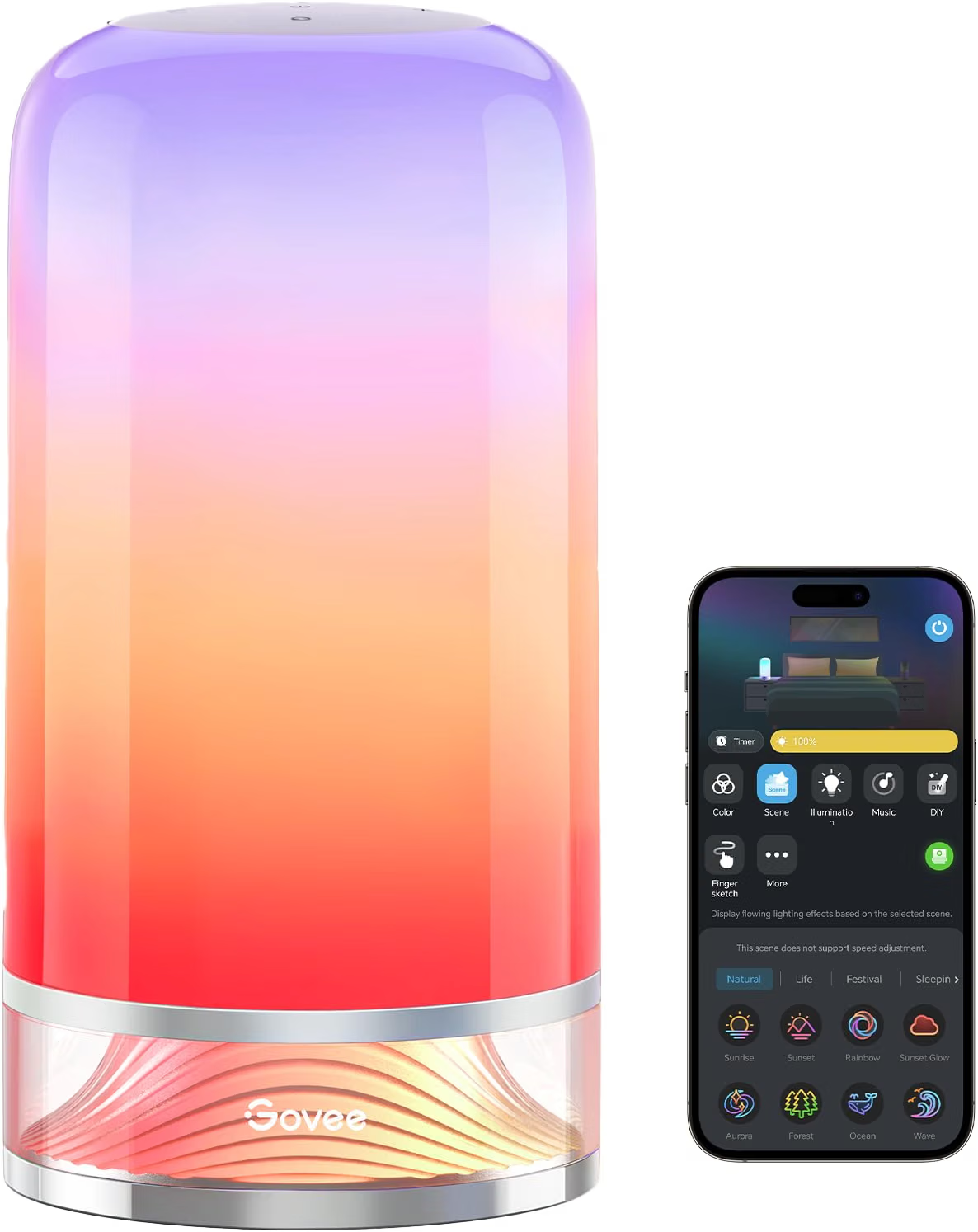
Lighting can influence how a room feels, how easily different activities can be performed, and how a space transitions from daytime to evening. A traditional bedside lamp generally provides a simple source of illumination, but modern smart lighting can offer additional ways to adjust color, brightness, and atmosphere without relying solely on a physical switch.
The Govee RGBIC Smart Table Lamp 2 is a compact, corded table lamp designed for bedside tables, desks, shelves, and other small spaces where decorative and functional lighting are useful. It combines touch-based controls with smart lighting capabilities, allowing users to adjust the lamp according to different situations.
The concept behind a smart table lamp is straightforward. Instead of treating lighting as a fixed feature of a room, the lamp becomes something that can be adjusted throughout the day. A brighter setting can support reading or working, while softer illumination can create a calmer environment in the evening. Color lighting can also be used when the goal is decorative rather than task-oriented.
One reason smart table lamps have become popular is their flexibility. A single lamp can serve several purposes without requiring different bulbs, shades, or fixtures. Depending on the available controls and software, users can change brightness, select colors, create lighting scenes, and incorporate the lamp into broader smart-home routines.
The Govee RGBIC Smart Table Lamp 2 is therefore best understood as more than a conventional bedside light. It is a small connected lighting device designed to provide customizable illumination while occupying relatively little space.
This guide explores its main features, possible uses, setup considerations, smart lighting concepts, and factors worth thinking about before adding a smart table lamp to a bedroom, office, living space, or other area of the home.
Understanding the Govee RGBIC Smart Table Lamp 2
The lamp is designed around the idea of combining everyday table lighting with programmable RGBIC illumination.
RGBIC refers to a type of LED lighting technology that can support multiple lighting colors or segments within a lighting effect rather than treating the entire light source as one single color.
That distinction can matter when creating decorative scenes. Instead of simply choosing between white, red, blue, or another single color, compatible RGBIC lighting can create more dynamic combinations and visual effects.
For a bedside lamp, this provides two broad categories of use.
The first is practical lighting. The lamp can provide illumination for activities such as reading, getting ready for bed, organizing a nightstand, or working at a desk.
The second is ambient lighting. Different colors and scenes can change the visual character of the surrounding space without requiring additional decorative lights.
Because the Govee RGBIC Smart Table Lamp 2 is corded, it is intended to operate from a connected power source rather than functioning as a battery-powered portable lamp. This can make it suitable for locations where the lamp will remain in one place.
Key Features
RGBIC Color Lighting
One of the defining characteristics of this lamp is its RGBIC lighting capability.
Traditional lamps usually focus on producing a particular white-light output. RGB lighting adds the ability to select colors, while RGBIC technology can support more complex multi-color effects.
This can make the lamp useful for different moods and room styles.
For example, warm-toned lighting may complement an evening environment, while colorful lighting can be used for entertainment, gaming, celebrations, or decorative purposes.
The important point is that color lighting is not necessarily a replacement for task lighting. Different activities require different levels and qualities of illumination. Users may therefore want to choose practical settings for reading or working and reserve stronger colors or dynamic scenes for ambient use.
Touch Control
The Govee RGBIC Smart Table Lamp 2 incorporates touch-based interaction.
Physical touch controls can be convenient when the lamp is being used as a traditional bedside light. A user does not necessarily need to reach for a smartphone every time they want to make a simple adjustment.
This creates a useful distinction between local and smart control.
Local controls are convenient for immediate adjustments, while connected controls can provide additional customization and automation options.
For a bedside lamp, having a physical control method can be particularly practical because using a phone at night is not always desirable.
Dimmable Lighting
Adjustable brightness is another useful characteristic of a modern table lamp.
A fixed brightness level may work well for one activity but feel excessive or insufficient in another situation.
For example, a person reading at a desk may want more illumination than someone using the lamp as a subtle nighttime accent.
Dimming allows the lamp to adapt to those changing circumstances.
It can also help create a more comfortable transition between brighter daytime lighting and lower evening illumination.
Brightness should still be selected according to the activity and the user’s visual needs. A very dim setting may be appropriate for ambience but not necessarily for reading small text.
Compact Tabletop Design
The lamp is designed for small surfaces.
A compact footprint can be useful on a bedside table, office desk, bookshelf, dresser, or side table where available space is limited.
Small lighting fixtures can be particularly helpful in modern workspaces because desks often have to accommodate monitors, keyboards, charging accessories, notebooks, and other equipment.
The lamp can provide a dedicated lighting source without requiring a large floor fixture or wall installation.
Corded Operation
Unlike rechargeable portable lamps, a corded table lamp is designed to remain connected to a power source.
This has both advantages and considerations.
The main advantage is that users do not have to remember to recharge the lamp.
For a bedside or desk lamp that remains in one location, continuous access to power can be convenient.
The trade-off is that the lamp needs to be positioned close enough to a suitable outlet, and the power cable becomes part of the room’s cable-management considerations.
Keeping the cord away from areas where it could be pulled, pinched, or become a tripping hazard is an important part of safe setup.
Smart Lighting Controls
Smart functionality expands the ways the lamp can be used.
Depending on the supported Govee ecosystem and available functions, users may be able to configure lighting through a compatible application.
Smart control can be useful when the goal is to adjust settings without physically reaching the lamp.
It can also provide access to lighting scenes and other customization options that are difficult to reproduce with a basic table lamp.
Software-based functionality can change over time, so users should check current product documentation and application support for the latest capabilities.
How the Govee RGBIC Smart Table Lamp 2 Can Be Used
Bedside Lighting
A bedside table is one of the most natural locations for a compact smart lamp.
The lamp can provide illumination for reading, preparing for sleep, checking a clock, organizing personal items, or simply creating a softer light source than a main ceiling fixture.
The ability to adjust brightness can be particularly useful here.
A brighter setting may be appropriate when reading, while a lower setting can provide enough illumination for moving around the room without creating the same level of brightness as a primary overhead light.
Reading
Table lamps are commonly used as reading lights, but the appropriate lighting level depends on the room, reading material, distance, and individual visual preferences.
A dimmable smart lamp provides flexibility because the user can adjust the brightness rather than being restricted to one fixed output.
When reading for extended periods, the lamp should be positioned to reduce glare and shadows on the page.
The exact placement depends on whether the user is right- or left-handed and whether the reading material is physical or displayed on a screen.
Bedroom Ambience
Smart color lighting can serve a decorative role in a bedroom.
Instead of relying exclusively on the room’s main light, users can create a secondary light source that contributes to the overall atmosphere.
A subtle color can complement bedroom décor, while dynamic scenes can provide a more noticeable visual effect.
Because the lamp is relatively compact, it can also fit into spaces where larger decorative lighting fixtures would be impractical.
Children’s Rooms
A small table lamp can also have practical uses in a child’s room, such as providing gentle evening illumination or serving as a decorative light.
However, children’s rooms require additional attention to placement and electrical safety.
The lamp and its cord should be positioned where young children cannot easily pull the device from a table or interfere with the power connection.
Colorful lighting can also be entertaining, but it should not be assumed that every lighting effect is appropriate for every child or situation.
Home Office
A smart table lamp can complement a home-office lighting setup.
During work, an appropriate neutral or white lighting setting may be useful for illuminating documents and the surrounding desk area.
Outside work hours, the same lamp can switch to a lower brightness or decorative color setting.
This makes the lamp adaptable without requiring separate lighting equipment for every purpose.
A desk lamp should also be positioned carefully to minimize reflections on computer monitors.
Gaming Spaces
RGB lighting is commonly associated with gaming environments because color effects can contribute to the visual design of a room.
The Govee RGBIC Smart Table Lamp 2 can potentially serve as an ambient accent next to a monitor, on a desk, or elsewhere in a gaming area.
Color scenes can complement other lighting elements without necessarily requiring the entire room to be illuminated by RGB lighting.
The lamp can therefore function as one element within a broader lighting arrangement.
Entertainment Areas
Smart color lighting can also be useful when watching movies, listening to music, or entertaining guests.
A subtle ambient setting may complement the room without becoming the main source of illumination.
For gatherings, colorful lighting can provide a decorative effect without requiring specialized event lighting.
Because preferences vary, adjustable settings make it possible to change the atmosphere without physically replacing the lamp.
Desk and Study Areas
Students and remote workers often spend long periods at desks.
A small lamp can provide additional localized lighting for notebooks, books, or other materials.
The key is to balance brightness with the rest of the room’s lighting.
A desk that is dramatically brighter than the surrounding room can create visual contrast that some users may find uncomfortable. A balanced lighting environment is generally easier to work with.
Creating Different Lighting Environments
One advantage of smart lighting is the ability to treat lighting as part of a routine.
A lamp can have one setting for morning activities, another for work, and another for evening relaxation.
For example, a simple routine might involve brighter practical lighting during the day and softer illumination later in the evening.
Color scenes can be reserved for occasions when decorative lighting is desirable.
The value of these settings is not necessarily the number of available colors. It is the ability to adapt the same physical lamp to different activities.
This can make a small lamp more versatile than a traditional fixture with a single fixed operating mode.
Who May Find This Type of Lamp Useful?
Smart-Home Users
People already using connected lighting products may appreciate adding another controllable light source to their environment.
A smart lamp can become part of a broader approach to room lighting, particularly when users already rely on smartphone-based controls or other compatible smart-home features.
People Who Want Flexible Bedroom Lighting
A bedroom may require different lighting levels throughout the day.
Bright light can be useful for practical tasks, while softer lighting may be preferred during relaxation.
A dimmable lamp with color options provides several possibilities within one device.
Remote Workers and Students
People who spend significant time at a desk may benefit from having a dedicated light source that can adapt between work and leisure.
The same lamp can support practical illumination during study or work and provide ambient lighting when the desk is being used for entertainment.
Users Interested in Decorative Lighting
RGBIC lighting can be appealing to people who want lighting to contribute to room design.
Rather than treating a lamp as purely functional, users can incorporate it into the visual identity of a bedroom, office, gaming area, or living space.
Important Things to Consider
Check the Available Space
Before placing a table lamp on a nightstand or desk, consider how much surface area is available.
A lamp should not interfere with books, electronics, glasses, charging equipment, or other objects that need to remain accessible.
Its position should also allow the light to illuminate the intended area without creating unnecessary glare.
Think About Cable Management
Because the lamp is corded, cable placement matters.
The power cable should have a clear route to the outlet and should not be stretched tightly.
Avoid placing cables where they can become trapped beneath furniture or create a trip hazard.
A tidy cable arrangement can also make the lamp easier to reposition when necessary.
Understand RGBIC vs. Traditional Lighting
RGBIC lighting is designed primarily for color effects and ambient customization.
It should not automatically be considered equivalent to a dedicated task-lighting fixture.
If the lamp will primarily be used for reading or detailed work, users should consider whether its available white-light settings and brightness range are appropriate for those activities.
Consider Smartphone and App Requirements
Smart functionality may involve application setup and account configuration.
Users should be comfortable with the software requirements associated with connected lighting.
It is also worth checking whether the desired features require a particular mobile operating system, network configuration, or application version.
Internet and Network Considerations
Connected lighting can depend on network connectivity for certain functions.
If the lamp is being integrated into a smart-home environment, reliable WiFi can improve the overall experience.
Users should also understand what happens to local controls and existing settings if the network becomes temporarily unavailable.
Consider Bedroom Placement
A bedside lamp should be positioned securely.
It should not be placed where bedding, curtains, or other materials can interfere with the lamp.
The power cord should also be arranged so that it cannot easily be pulled from the table.
These details may seem minor, but proper placement is an important part of using any corded electrical device safely.
Smart Table Lamp vs. Traditional Table Lamp
A traditional table lamp generally focuses on straightforward illumination.
Its controls may consist of a switch, touch sensor, or dimmer, depending on the model.
A smart table lamp adds connected functionality and more customization.
The difference is not necessarily that one type is universally more useful. It depends on what the user wants from the lighting.
Someone who simply needs a light source may not need smart features.
Someone who wants adjustable colors, scenes, app-based control, and programmable lighting may appreciate the additional functionality of a smart model.
Smart lighting can also introduce more setup than a conventional lamp.
Smart Table Lamp vs. Smart Bulb
A smart bulb is designed to make an existing compatible light fixture controllable.
A smart table lamp integrates the lighting source and fixture into one device.
A smart bulb can therefore provide flexibility if someone already owns a lamp they like.
A smart table lamp can be more straightforward when the user wants a complete lighting fixture without selecting a separate bulb.
The choice depends on the room, existing equipment, desired appearance, and level of customization.
RGB Lighting vs. Standard White Lighting
Standard white lighting is generally associated with everyday illumination.
RGB or RGBIC lighting adds color options for decorative and atmospheric purposes.
Neither category has to replace the other.
A room can use practical white lighting for activities and colorful accent lighting for relaxation or entertainment.
A lamp capable of switching between these different roles can be useful for people who want flexibility without installing several separate fixtures.
How to Approach Smart Lamp Setup
Setting up a smart table lamp generally involves two stages: physical installation and software configuration.
Start by placing the lamp on a stable, appropriate surface.
Connect the power cable according to the manufacturer’s instructions.
After powering the lamp, follow the current Govee application instructions for connecting and configuring the device if smart control is desired.
Once connected, give the lamp a simple name.
A clear name makes it easier to identify the lamp later if multiple smart lights are present.
After basic setup, test the physical touch controls and connected controls separately.
Then experiment with brightness, colors, and scenes.
It is generally easier to create useful routines after understanding the lamp’s basic functions.
Making Smart Lighting Practical Rather Than Complicated
Smart lighting can become unnecessarily complicated if every possible feature is used at once.
A simpler approach is often more practical.
Start with one or two lighting settings that match everyday needs.
For example, users might create a comfortable evening setting and a brighter daytime setting.
Once those are working reliably, additional scenes can be added for entertainment, gaming, seasonal decoration, or other occasions.
The goal is to make lighting easier to manage rather than turning a simple bedside lamp into a complicated project.
Frequently Asked Questions
What is RGBIC lighting?
RGBIC is a type of LED lighting technology that can support multiple colors or lighting segments within an effect.
Compared with simple single-color lighting, it can create more dynamic and decorative visual scenes.
Is the Govee RGBIC Smart Table Lamp 2 suitable for a bedside table?
Its compact tabletop design makes it suitable for spaces such as bedside tables, desks, and other small surfaces, assuming the available space and power outlet are appropriate.
Is the lamp rechargeable?
The product is described as a corded table lamp, so it is designed to operate from a connected power source rather than being treated as a rechargeable portable lamp.
Can the lamp be dimmed?
The product is designed with adjustable lighting functionality, allowing users to adapt brightness for different situations.
Exact controls and available ranges should be confirmed in the current product documentation.
Can I use it for reading?
A table lamp can provide useful reading illumination, but the appropriate brightness depends on the user’s environment and preferences.
Users should position the lamp carefully to reduce shadows and glare.
Can RGBIC lighting be used as the main room light?
It can contribute to room illumination, but colorful ambient lighting is not necessarily a substitute for dedicated general or task lighting.
For activities requiring clear visibility, an appropriate white-light source may be more suitable.
Can the lamp be used in a home office?
Yes, a compact smart table lamp can be useful in a home office for desk illumination and ambient lighting.
Positioning is important to reduce reflections on monitors and shadows over work materials.
Can it be used in a gaming setup?
RGBIC lighting can be incorporated into gaming spaces as ambient or decorative lighting.
The lamp can provide an additional lighting element without requiring an entire room to be equipped with RGB fixtures.
Does smart functionality require an app?
Smart lighting products commonly use a companion application for configuration and advanced controls.
Users should follow the manufacturer’s current setup instructions to determine which functions are available through the application.
Does the lamp need WiFi?
Connected features may depend on network connectivity, depending on the specific function and ecosystem being used.
The lamp’s basic physical controls may operate differently from cloud or app-dependent functions.
Can I use different colors throughout the day?
Color customization is one of the purposes of RGBIC lighting.
Users can select different colors or scenes depending on their preferences and the activity taking place.
Is a smart lamp better than a traditional lamp?
The two types serve different needs.
A traditional lamp emphasizes simple operation, while a smart lamp adds connectivity, customization, and automation possibilities.
The more appropriate option depends on whether those additional features are useful in the user’s environment.
Where can a smart table lamp be placed?
Common locations include bedside tables, desks, shelves, dressers, side tables, and entertainment areas.
The surface should be stable, and the lamp should be positioned safely near a suitable power source.
Can the lamp replace a ceiling light?
A small table lamp is generally intended as localized or ambient lighting rather than a universal replacement for a room’s primary lighting.
Its effectiveness depends on the size of the room and the intended activity.
Tips for Getting More From a Smart Table Lamp
The easiest way to get value from a smart lamp is to think about the activities that happen around it.
If it is primarily a bedside lamp, prioritize comfortable brightness and convenient nighttime control.
If it is used at a desk, focus on practical illumination and minimizing reflections.
If it is part of a gaming or entertainment area, color scenes may become more important.
If it serves several purposes, creating a small number of distinct lighting presets can make switching between them easier.
Another useful principle is to avoid excessive brightness when it is unnecessary. A lamp does not have to operate at maximum output simply because it can.
Likewise, colorful lighting does not have to be intense to contribute to a room’s atmosphere. Subtle illumination can often work as an accent while allowing other room lighting to remain dominant.
Final Thoughts
The Govee RGBIC Smart Table Lamp 2 combines the familiar role of a compact tabletop light with the flexibility associated with modern smart lighting.
Its RGBIC capabilities can provide colorful and dynamic lighting effects, while adjustable brightness makes the lamp adaptable to more practical situations. Touch controls provide a convenient local interaction method, and connected functionality can expand the ways the lamp is managed and customized.
Its corded design makes it particularly appropriate for a permanent location such as a bedside table, desk, shelf, or side table. Users do not have to plan around battery charging, but they do need to consider outlet access and cable management.
The most useful way to approach a smart table lamp is as a flexible lighting tool rather than simply a decorative gadget. It can provide practical illumination when needed and shift toward ambient lighting when the room’s purpose changes.
Before setting one up, consider the available space, power connection, desired lighting style, software requirements, and the type of illumination needed for everyday activities. With those factors in mind, a smart table lamp can become a versatile part of a bedroom, home office, gaming space, or broader smart-home environment.
Leave a Reply